
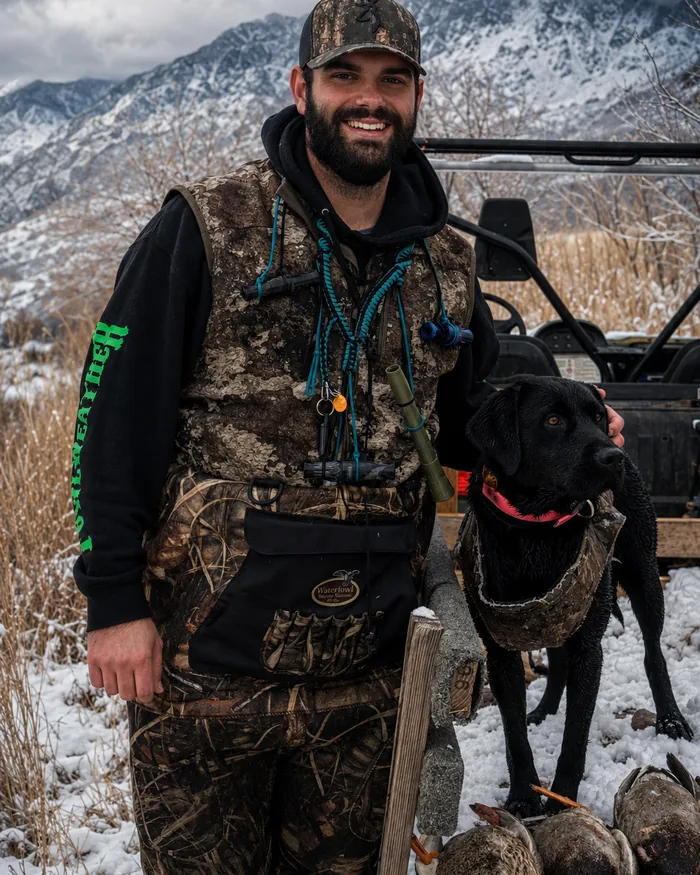
When a full-body beats a silhouette

Honestly, there are conditions where I would rather have a full-body. I am not going to tell you a silhouette beats a full-body in every situation.
If I have a private field, the truck is right there, I am hunting late-season educated birds, and it is a bright, calm day where those birds are going to make slow, close passes, that is where a full-body has the advantage. The birds have plenty of time to look at everything. They are close, they are circling slowly, and the three-dimensional shape of a full-body is tough to beat.
But those are not the only conditions we hunt in.
When a silhouette clearly wins
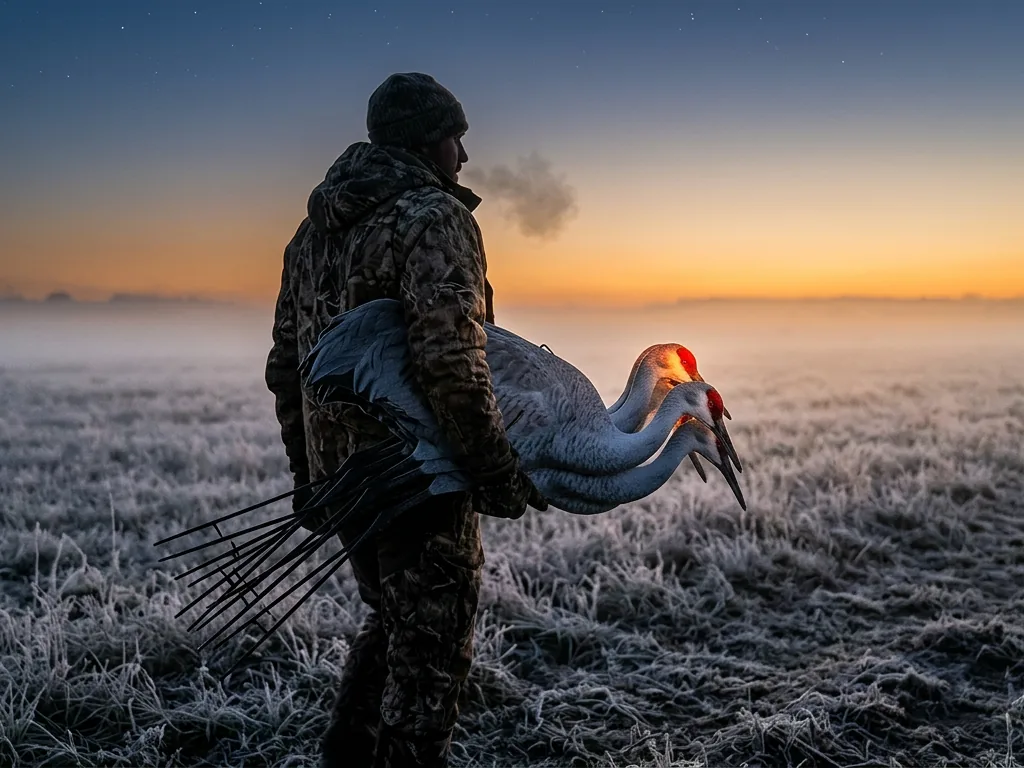
When weight, mobility and numbers matter. That is where silhouettes separate themselves.
A lot of hunters are walking into fields, dealing with wind and bad weather, limited access, and birds that are looking at a spread from hundreds of yards away. Try carrying six dozen full-body goose decoys any real distance. With silhouettes you can walk farther, hunt ground other guys do not want to walk into, and put more birds in the field without bringing a trailer.
They are also fast. You can put a big spread together without spending half the morning carrying and assembling decoys.
For walk-in hunts, public land, frozen fields, muddy fields, long hikes, or anytime the birds have moved and you need to move with them, I am taking silhouettes every time.
“They disappear edge-on”

This is the big objection, and my real answer is: yes, they can. That is a genuine limitation of a flat decoy, and I am not going to pretend otherwise.
But people make a bigger deal of it than they should. A bird is not coming straight down at one silhouette, staring at it from one exact angle. It is looking at the whole spread while it circles, banks, turns and keeps changing its perspective.
That is why how you set silhouettes matters. Do not put every bird facing the same direction. Mix your angles and your poses so the birds see different profiles as they work the spread.
The other thing people forget is that birds are not judging your decoy from five feet away. The decision to come look at your spread is usually made much farther out. Our Core All-Black silhouettes are designed around that: the matte black finish creates strong contrast that stands out at distance, especially in low light and on overcast days.
So yes, a silhouette has an edge-on limitation. That does not mean the birds stop seeing the spread.
What birds are actually looking at
Most of the time, the important part of the approach is when the birds are out in front of you and above the spread, looking down at the whole group rather than one decoy.
That is why I care much more about the overall footprint of the spread, the contrast and the movement than about whether one decoy looks perfect from one angle.
As they get closer, that is when I want the spread to get more convincing. Not because every decoy has to be three-dimensional, but because the whole group needs to look like birds that are comfortable using that field. If it is late season, clear and calm and they are circling low and slow, that is when close-range realism matters most, and it is the situation where I will admit a full-body has a legitimate edge.
The weight numbers

This is where the difference gets hard to ignore.
| Canada geese | Our silhouettes | Typical full-bodies |
|---|---|---|
| 1 dozen | about 6 lb | 20 to 40 lb |
| 4 dozen | about 24 lb | 80 to 160 lb |
| 6 dozen | about 36 lb | 120 to 240 lb |
Full-body weight varies a lot by model, which is why that column is a range. Our Immortal Canadas run about 6 lb a dozen, and our Core All-Black duck silhouettes are lighter still at about 3 lb a dozen.
That is the difference between throwing the whole spread in the truck and carrying a big spread into the field on your back. It is one of the biggest reasons silhouettes have a place in almost everybody's spread.
Shells and windsocks
They still have a place, and I look at them as tools, not as one style always being better.
Windsocks are great when you need volume and movement, especially for big snow goose spreads. They are light, they pack down small, and you can put a lot of birds in a field without a lot of gear.
Shells are a nice middle ground. You get some three-dimensional shape without the bulk of a full-body.
Silhouettes give you the footprint and visual presence of a big spread without paying for it in weight and storage.
You do not have to pick one. I have no problem mixing silhouettes, shells, full-bodies or windsocks if that is what the situation calls for.
What is in our own spread
I do not have one spread I use every time. I build it around where I am hunting, what species I am after and what the birds are doing.
For geese in a field, I usually start around four to six dozen and adjust from there. If the birds are finishing well, I do not care if I have 48 decoys or 100. I am not adding decoys just to say I have more.
I am not trying to sell somebody 200 decoys just because I can. I am trying to help them build the spread that makes sense for the way they hunt.
That is what gets lost in the silhouette-versus-full-body argument. They are both tools. The question is which one makes the most sense for the hunt you are actually going on.
Common Questions
Are silhouette decoys effective?
Yes, especially where weight, mobility and numbers matter: walk-in hunts, public land, frozen or muddy fields and long hikes. Birds decide whether to investigate a spread from far out, where contrast and footprint matter most.
When is a full-body decoy better than a silhouette?
On a private field close to the truck, with late-season educated birds on a bright, calm day where they make slow, close passes. There the three-dimensional shape of a full-body is hard to beat.
Do silhouette decoys disappear when birds are edge-on?
They can, which is a real limitation of a flat decoy. Setting silhouettes at mixed angles and poses gives circling birds different profiles, and birds judge the whole spread rather than one decoy.
How much do silhouette goose decoys weigh compared to full-bodies?
Our Canada goose silhouettes weigh about 6 lb a dozen. Full-body Canada decoys typically run 20 to 40 lb a dozen, so four dozen is roughly 24 lb against 80 to 160 lb.