
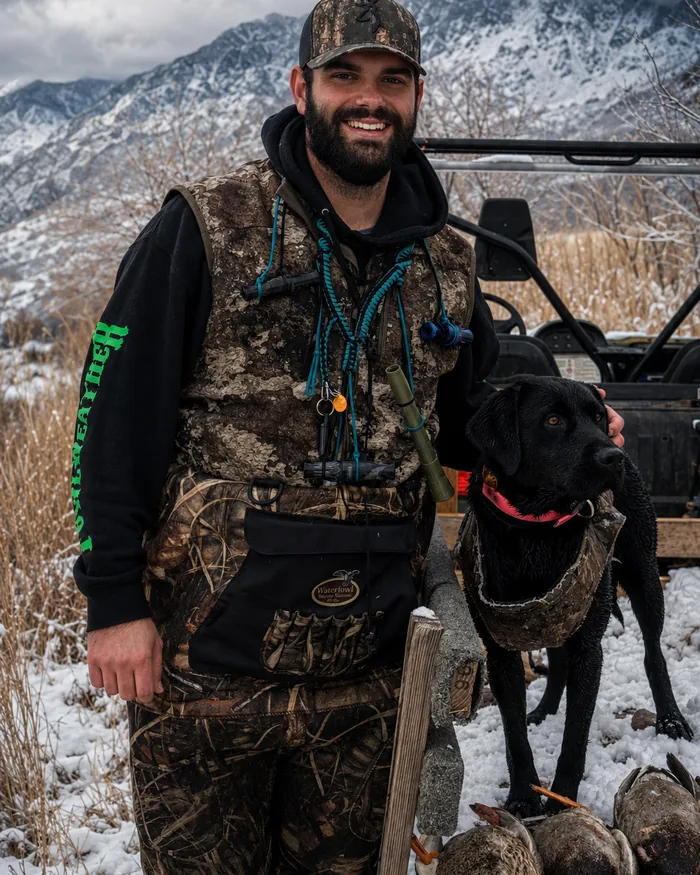
By water type
| Water | Ducks | The idea |
|---|---|---|
| Open water | 2 to 4 dozen | A bigger footprint, visible from a distance |
| Flooded timber | 6 to 18 | Tight groups. The trees do some of the work |
| Small sloughs | 6 to 18 | A few ducks using the spot, not a refuge |
Match the spread to the water
Open water
Spread the decoys out and use a larger footprint, roughly two to four dozen depending on the size of the water and how many birds are using it. Keep the spread visible from a distance while still holding a defined landing pocket. On windy days, make it longer and more directional so it works with the wind instead of looking like a round pile of decoys.
Flooded timber
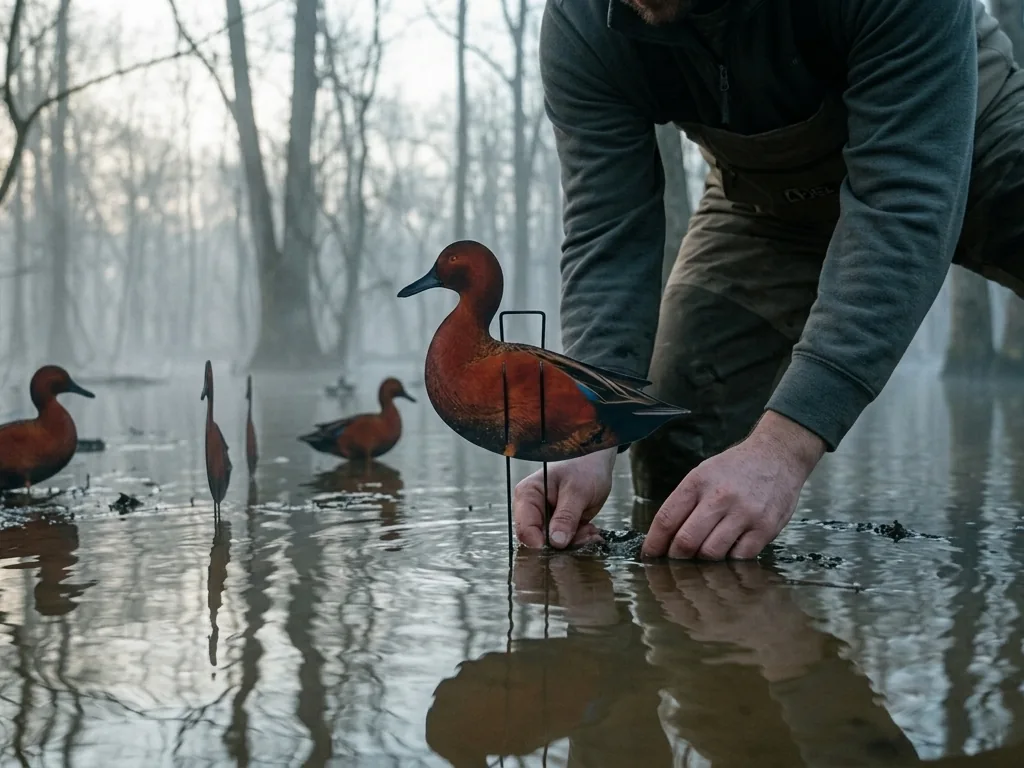
Use fewer decoys in tighter groups, roughly six to 18 ducks and sometimes fewer. The trees already break up the outline and give the birds plenty to look at. Put small family groups in openings, along edges and near the downwind side of the hole. Do not fill every pocket. The timber itself is part of the spread.
Small sloughs
Run roughly six to 18 decoys depending on the size of the opening. Make it look like a few ducks are using that particular piece of water, not like a little slough is a major refuge.
On small water, placement matters more than count. A few decoys in the right spot can be more convincing than a dozen scattered everywhere.
Our default small-water mallard setup

Usually eight to 12 mallard silhouettes, set in a few small groups rather than one tight bunch.
I want the landing hole downwind of the main body of the spread and slightly off to one side of the blind. That gives the birds a clean place to finish without landing right on top of us.
On a little slough, I may put four to six decoys on one side of the hole and four to six on the other, leaving a clear pocket between them. If the water is narrow, I will often put the decoys along the bank or in the quieter end and leave the best-looking open water for the birds.
If the wind comes from the other direction, I rotate the whole setup. The exact shape is not important. What matters is that the birds can see the open water and have a comfortable place to finish.
Why mix species, and how much

I mix species when the real birds are mixing species. I am not adding teal or pintails just because more species automatically makes a spread better.
| Species | Share | When and where |
|---|---|---|
| Mallards | 70 to 80% | The foundation of a small-water spread when you are mostly seeing mallards |
| Teal | 10 to 20% | When you are seeing them, especially early season or on shallow water. Give them their own small group or the outside edges |
| Pintails | 10 to 15% | When they are using the property, or the spread needs more variety in profile |
| Gadwall | 10 to 25% | On larger water, late season, or anywhere you keep seeing them |
Teal are small, active birds, so I like giving them their own space. A few pintails can make a spread look more natural, but I do not want to turn a mallard setup into a random collection of species.
The rule is simple: the species mix should reflect the birds using the spot. If I am not seeing a species, I am not adding it just to fill space.
Where the landing hole goes
On water, I leave the hole downwind of the main body of the spread and slightly off the blind. I want the birds finishing into the wind with their attention on the open water, not on the hunters. On a small slough, use the widest or cleanest part of the opening. On open water, make the hole larger and more obvious, since there is more room. An irregular opening with a couple of natural-looking lanes beats a perfect circle.
In a field, I want the hole upwind of the blinds, because ducks and geese usually finish into the wind. Leave roughly 20 to 35 yards between the blinds and the center of the hole, adjusted for the species and how the birds are working. Make sure the hole is visible from their approach, and give them room to land without flying over a wall of decoys.
Motion and spinners with silhouettes
I run motion when the conditions call for it, but I do not treat it as automatic.
A spinner can be effective early in the season, on cloudy days, and when I need to get a duck's attention from a distance. I usually put it off to one side of the landing hole rather than in the middle of the spread, so the birds have something to look at without the hole itself looking wrong.
With silhouettes, motion is especially useful because it adds something they do not give you on their own. Silhouettes provide shape, contrast and footprint. The motion gives the spread life.
On pressured public water I am much more careful. If birds have been seeing spinners every day, I may pull it, cover it or switch to a jerk cord. A little ripple across the spread can look more natural than a bright, constant flash. Jerk cords, water keels and natural wind movement all work. On calm days a small amount of movement makes a big difference. On windy days I may not need a spinner at all.
Pressured public water
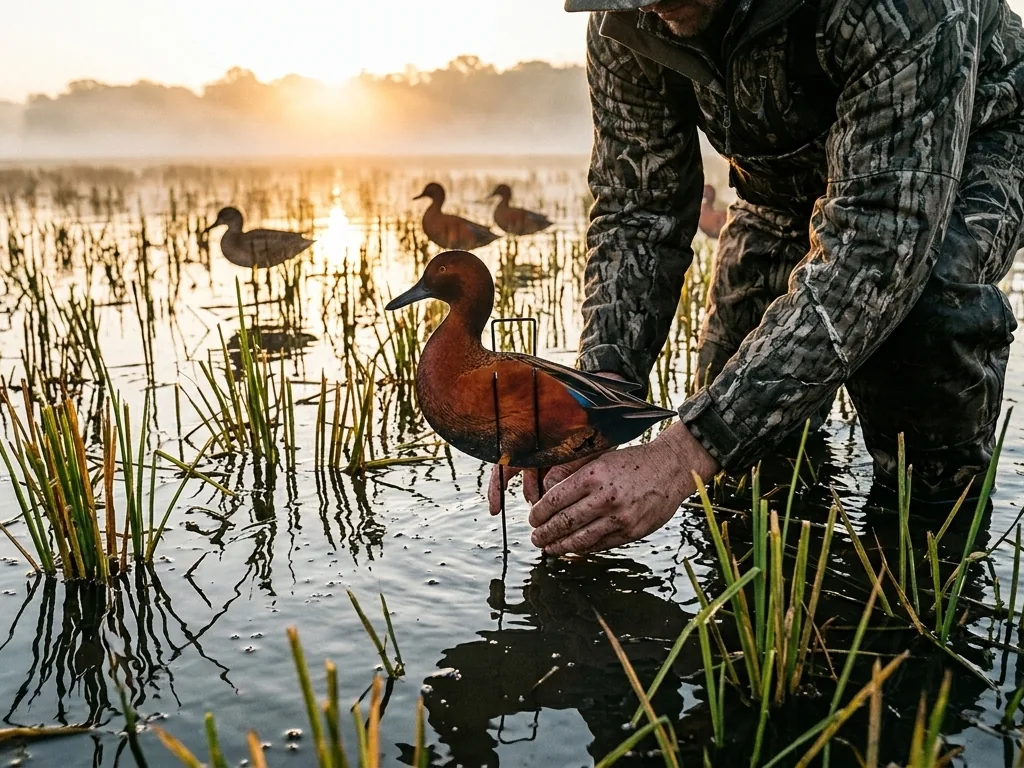
I simplify everything: fewer decoys, a smaller spread, more attention to concealment and access, and nothing that looks like every other spread on the lake. On a small public spot I may use six to 18 ducks, placed where the birds naturally want to be.
- Leave a clean hole, and do not crowd the best landing water.
- Make sure the spread does not interfere with other hunters.
- Scout where the birds are roosting, feeding, and traveling between the two.
The best spread in the world will not fix being in the wrong spot.
I am also willing to pull decoys. If birds keep landing short, swinging wide or avoiding the motion, I change the setup instead of assuming I need more gear.
Silhouettes in shallow water and mud
Shallow water and mud are two places silhouettes are especially useful, with a few adjustments.
Shallow water
- Seat the stakes firmly, and push them deeper if the bottom is soft.
- Do not let every decoy lean at the same angle.
- Make small, separated groups: a few along the edge, a couple near the open water, and a clean hole between.
Mud
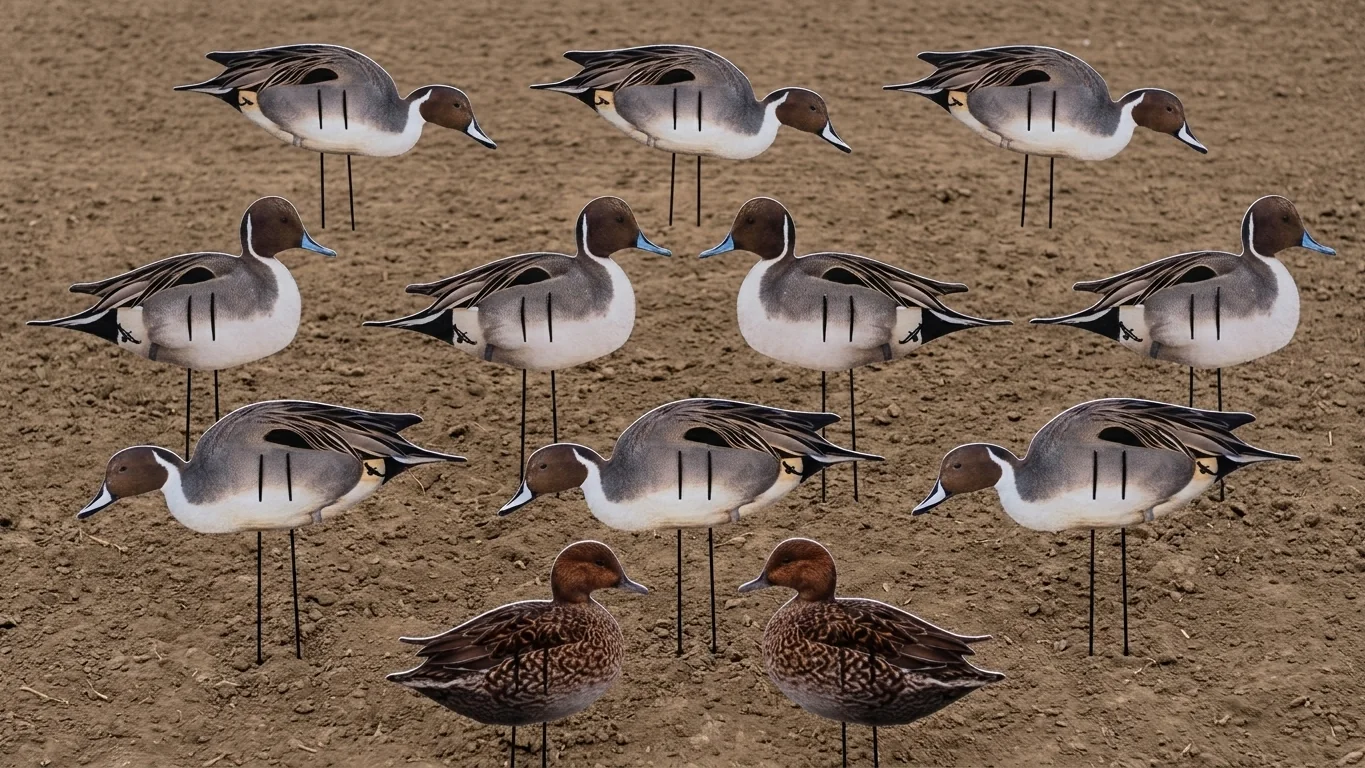
Mudflats can make a spread look flat, so spacing and orientation matter. Use different angles, leave room between groups, and never line silhouettes up like a fence. If the mud or water is bright, angle the silhouettes so they keep their contrast from the birds' approach. On dark, overcast days the black profile stands out extremely well.
Mud also usually means long walks, bad footing and changing water levels. Our duck silhouettes run about 3 to 5 lb a dozen, so you can carry a much bigger spread onto a mudflat than you could with full-bodies.
I would rather have eight to 12 silhouettes placed naturally along the edge of a little slough than 30 decoys packed into the only open water.
The birds already understand the habitat. You are just showing them a believable group using it.
Common Questions
How many duck decoys do you need for small water?
Roughly six to 18 on a small slough, depending on the size of the opening. A default small-water mallard setup is eight to 12 silhouettes in a few small groups.
How many decoys for flooded timber?
Roughly six to 18 ducks and sometimes fewer, in tight groups. The trees break up the outline, so you do not need to fill every opening.
Where should the landing hole be on water?
Downwind of the main body of the spread and slightly off to one side of the blind, so birds finish into the wind looking at the open water instead of the hunters.
Should I mix duck species in my spread?
Only when the real birds are mixing. Mallards are usually 70 to 80 percent of a small-water spread, with teal, pintails or gadwall added in proportion to what is actually using the spot.
Should I use a spinning wing decoy?
It can help early in the season, on cloudy days, or to get attention from a distance. On pressured public water, consider pulling it or switching to a jerk cord for more natural movement.