
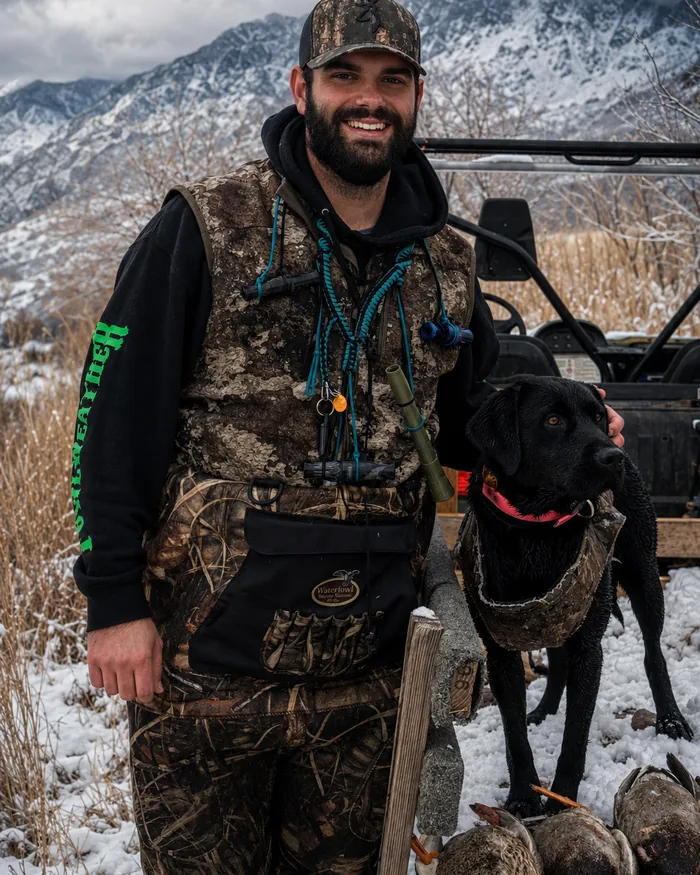
Start with the hole, not the decoys
The biggest mistake I see is setting the decoys first and trying to find the landing hole afterward.
The hole should be the first thing you decide. Where do I want the birds to finish? What direction will they come from? Where can I hide the blinds? Answer those and the rest of the spread gets much easier.
The exact shape changes with the field, the wind and where the birds want to finish. Sometimes I make it more of a J, sometimes a loose V, and sometimes two family groups with a hole between them. But the principle stays the same: the birds need to see a clean, inviting finish, and the hunters need to be hidden where the birds are looking least critically.
The landing hole and the wind
I generally want the landing hole upwind of the blinds, because geese usually finish into the wind. That gives me a predictable line of approach and keeps the birds moving toward the hole instead of trying to land behind us or off to one side.
I do not want the hole right on top of the blinds. I want enough room for the birds to finish comfortably, usually 20 to 35 yards in front of the blinds, depending on the field and how the birds are working.
The hole also has to be visible from the direction the geese are coming. A beautiful hole hidden behind a wall of decoys is not doing anything for you.
Where the blinds go
I put the blinds downwind of the landing hole, usually just outside the main body of the spread. I want the birds finishing in front of us, not directly over our heads or behind us.
What people get wrong:
- Putting blinds where it is convenient for the hunters. People find a good clump of grass, dig in, and build the spread around the blinds. Decide where the birds need to finish first, then hide the blinds to fit.
- Bunching them up. Blinds packed together can look like one big unnatural object.
- Setting them too far downwind. The birds may finish short of the guns.
- Leaving them exposed because they assume the decoys will hide them. They usually will not. The blinds need to disappear from the birds' line of sight, not just from the hunters' point of view.
The mix: feeders, walkers, lookers, sleepers
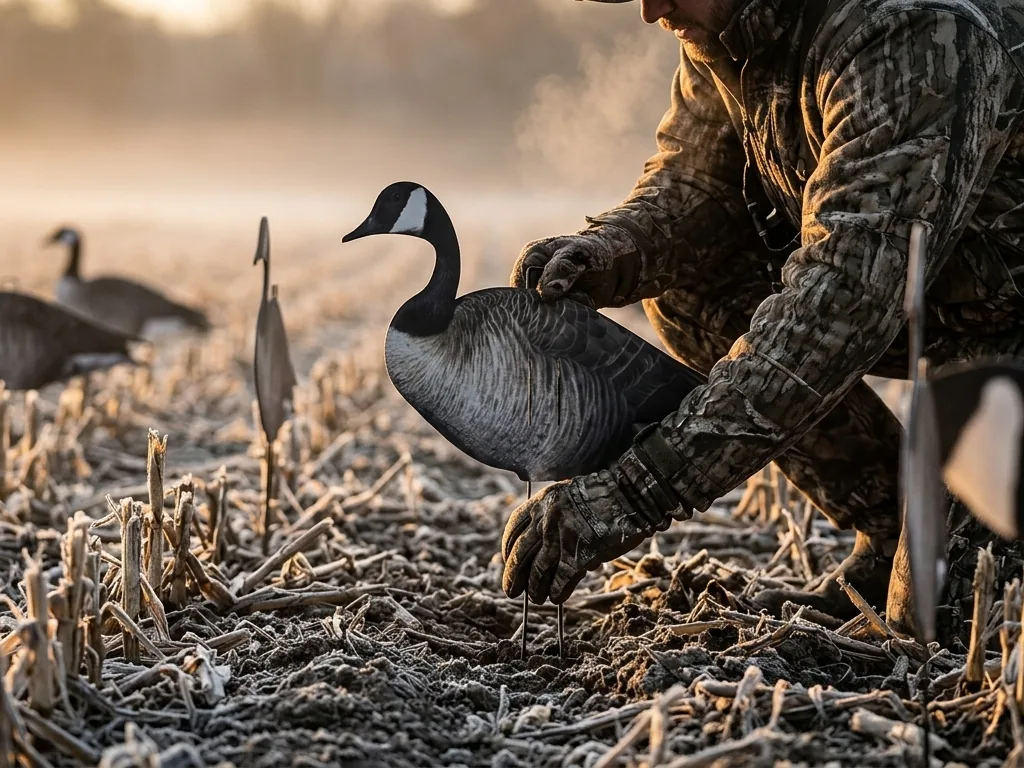
I do not get rigid about exact ratios, but for a Canada spread I like roughly:
| Pose | Share of spread | Where it goes |
|---|---|---|
| Feeders | 50 to 60% | The main body, especially the downwind and side edges |
| Walkers | 20 to 25% | Around the outside and between groups, to break up straight lines |
| Lookers | 15 to 20% | The upwind edge, the sides, or near the hole |
| Sleepers | A few | Toward the center or a quiet side group, never around the hole |
Feeders make up the bulk because that is what a relaxed feeding group looks like. A few upright lookers make the spread look alert without every bird watching the sky. Sleepers are good in a relaxed family group, but too many make the spread look flat and lifeless.
Real geese are messy. They are not arranged like a showroom display.
Our Immortal Canadas come mixed in feeders, walkers and searchers, so a dozen already gives you some of that variety.
What changes for snows
For snow geese I usually make the spread larger, looser and more irregular.
Snows are comfortable in big groups, so I want more visual mass. I will often use several loose family groups instead of one tight cluster, with open lanes between them.
Movement matters more with snows. Windsocks, rags and other motion can help, especially when the wind is light. I still want a landing area, but it may be broader than I would use for Canadas.
With snows I am less worried about each decoy looking perfect. I am trying to create the impression of a large, active group of birds using the field.
What changes for specks
Specklebellies get a more deliberate spread. I do not need the numbers I would use for snows, and I am careful not to make it look like a random pile of birds.
I like smaller family groups with more space between them, and I pay close attention to the landing hole. Specks can be very particular, especially late in the season, so the spread has to look relaxed and believable.
I still use a good number of feeders, but I run more lookers and upright birds than in a Canada spread. Specks are social and vocal, and a few alert birds make the group look active without looking nervous.
October versus January
In October I run smaller, simpler, tighter spreads. The birds are less educated, family groups may still be small, and I do not need to overwhelm them. Often two to four dozen Canadas, depending on the field and how many birds are using it, with an obvious landing hole and nothing complicated.
By January I am more likely to run four to eight dozen or more, especially on a big field or somewhere holding a lot of birds. I spread the groups out, build more realistic family units, and give the birds more places to look.
Late-season birds have seen a lot of spreads. They may circle longer, come from different directions, and avoid anything that looks too perfect. That is when spacing, concealment and matching what the birds are actually doing matter most.
I may run more silhouettes late in the season too, because they let me grow the spread without adding much weight. If I have to walk a long way in January, that matters even more.
Check it from the birds' side

A few more mistakes worth avoiding:
- Too symmetrical. Geese do not sit in perfect rows, circles or evenly spaced lines. Use different group sizes, spacing and angles.
- Decoys too close to the blinds. Hunters want birds close, so they build the spread right around themselves. That can make birds finish short or land behind you.
- Never looking at it from the birds' side. Walk well away from the blinds and look back. If you can see the blinds, a straight line of decoys, or an empty spot that does not read as a landing hole, fix it before the hunt.
How long setup should take

For a normal Canada spread of four to six dozen, 30 to 45 minutes is reasonable once you know the field and have a system. A smaller October spread might take 15 to 25 minutes. A big snow spread or a complicated late-season setup can take an hour or more, especially if you are carrying everything a long way.
But speed should not be the goal. The goal is setting it right the first time.
I would rather spend an extra ten minutes checking the landing hole, moving the blinds and breaking up a bad line than spend the morning watching birds avoid a spread that was thrown together.
Silhouettes do make it faster. They pack tight, weigh very little and need far less assembly than full-bodies, which is a big reason we like them for large spreads and walk-in hunts.
What is in our own Canada spread
For a typical field hunt, I start with four to six dozen Canada silhouettes, mixed feeders, walkers and lookers. I build two or three family groups, leave a clean landing hole upwind of the blinds, and adjust the outside edges based on how the birds are approaching.
If the birds are finishing well, I stop adding decoys. If they are landing short, I move the blinds or open the hole before I add anything.
I am not trying to build the biggest spread. I am trying to build the clearest invitation.
Common Questions
Where should the landing hole be in a goose spread?
Upwind of the blinds, because geese usually finish into the wind. Leave roughly 20 to 35 yards between the blinds and the hole, and make sure the hole is visible from the direction the birds approach.
Where should goose blinds go?
Downwind of the landing hole, just outside the main body of the spread, so birds finish in front of the hunters rather than over them. Do not bunch blinds together or set them too far downwind.
What ratio of feeders to lookers should a goose spread have?
Roughly 50 to 60 percent feeders, 20 to 25 percent walkers, 15 to 20 percent lookers and a small number of sleepers. Avoid having every decoy face the same way.
How is a snow goose spread different from a Canada spread?
Larger, looser and more irregular, built from several loose family groups with open lanes, and with more movement such as windsocks. The landing area can be broader.
How long does it take to set a goose spread?
About 30 to 45 minutes for four to six dozen Canadas once you have a system. A small early-season spread takes 15 to 25 minutes, and a big snow or late-season spread can take an hour or more.